Protocols and papers
Thetabase
A five-page design brief for a standalone JSON caching library that reuses saved work and rechecks access before returning it.
Design brief · local runs, not production
- Printed title
- Thetabase: Reuse useful work. Recheck access. Adapt between runs.
- Format
- PDF, 5 pages
- Date
- September 2026
- What is published
- The design brief only. The library code and reproduction kit are not published here.
What it means
Saved work can be reused, but a saved result never carries permission with it: the host's access check runs again on each request.
The design starts with whole-job caching and adds reuse of intermediate stages only where measurements justify it. Which strategy to use is decided offline from recorded runs, then fixed for later requests, so the live path stays simple.
Saved computation never saves permission.
Page 2
Start with complete-result caching. Add reusable stages only where the measurements justify them.
Page 2
How it functions
The brief walks the pipeline (input, access check, compute or reuse, recheck, output), the two caching levels, and a Replay, Compare, Configure loop for choosing a strategy offline. Its rule is that reuse must save more compute than it costs in lookup, copying, and profiling.
Page 5 shows two reproduce commands and a five-line Python integration example in which the host supplies the access check. The commands refer to a separate kit that holds the library, reproduce.py, raw timings, and hashes. That kit is not published here, so this page offers the design and the reported figures, not runnable code.
Status and claim boundary
A design brief describing a prototype. Its measurements are local end-to-end runs, not production traffic. On repeated queries over one unchanged HTML page, hybrid stage reuse took 1.58 seconds against 9.62 for whole-job caching, which the brief reports as 84% less execution time. On simple JSON reports, whole-job caching was faster (3.21 seconds against 4.94 for hybrid), and on a cold single query hybrid was 7% slower.
Data boundary, in the brief's own terms: deterministic JSON with safe integers only; floats are rejected, and float and vector support is future adapter work. No universal crossover threshold is claimed, and the brief states that its design influences do not establish novelty or production validation.
Figures from this paper
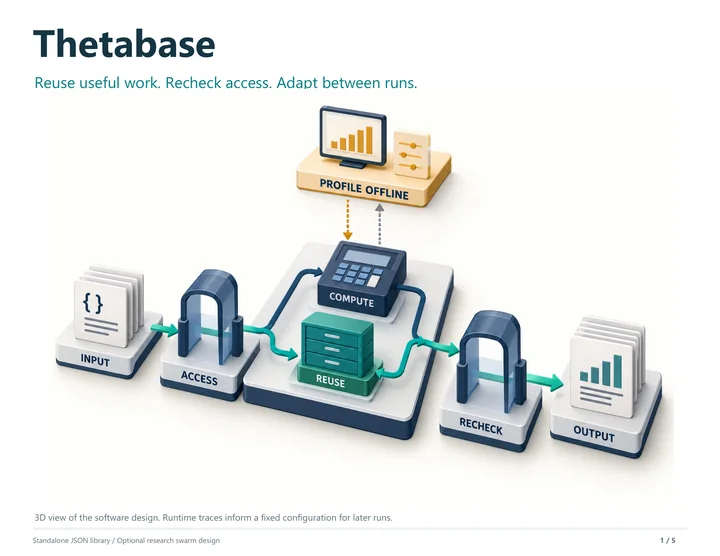 Thetabase, page 1 of 5: Reuse useful work. Recheck access. Adapt between runs.
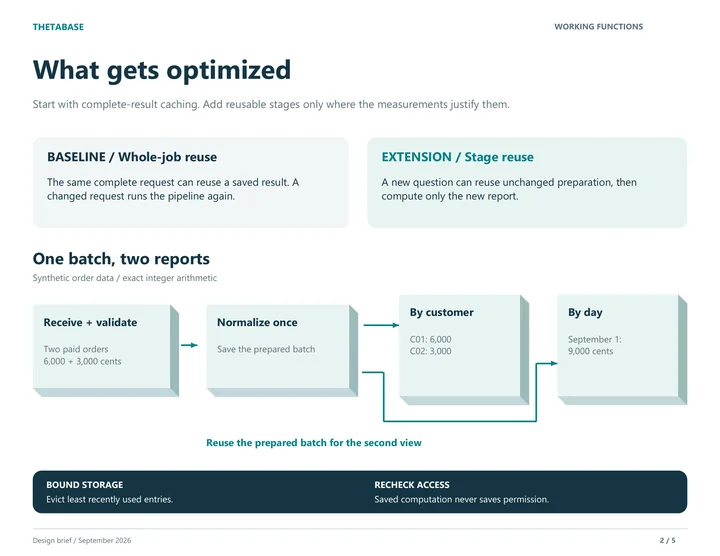 Thetabase, page 2 of 5: What gets optimized
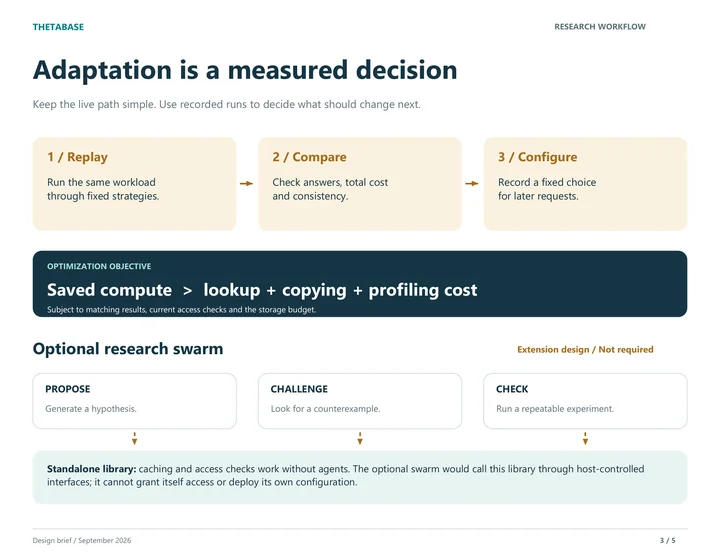 Thetabase, page 3 of 5: Adaptation is a measured decision
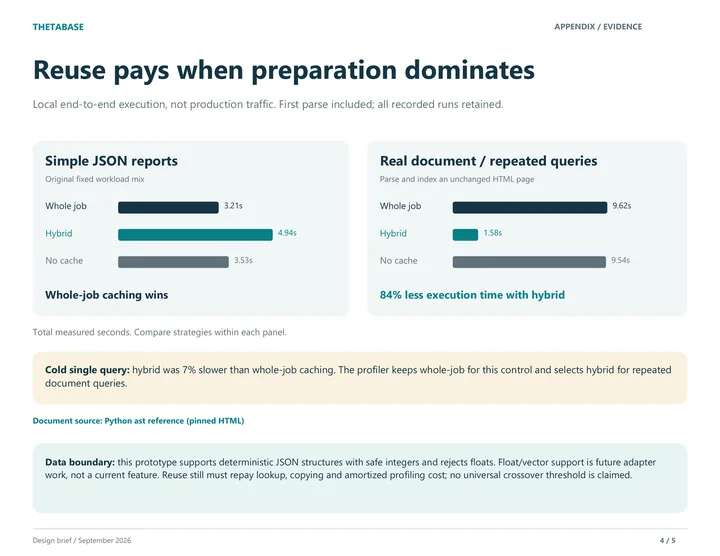 Thetabase, page 4 of 5: Reuse pays when preparation dominates
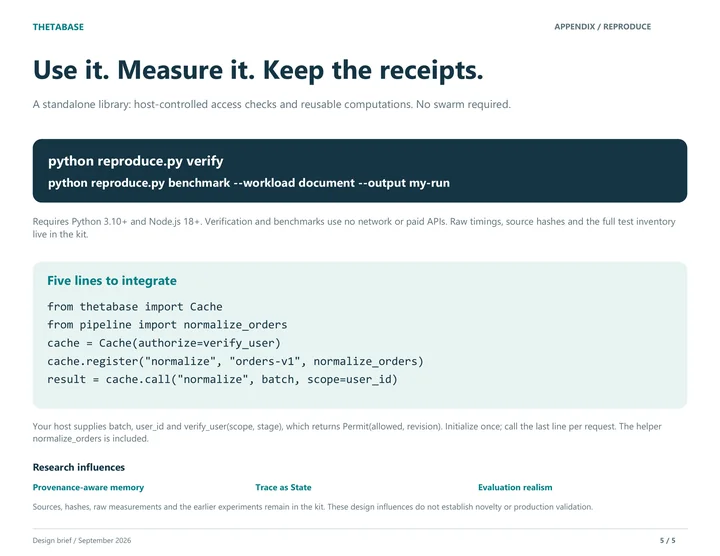 Thetabase, page 5 of 5: Use it. Measure it. Keep the receipts.